Independent living design focuses on creating bathrooms that people can use safely, easily, and without assistance. It goes beyond accessibility by considering how a space performs in real use - such as how easy it is to operate tapware, maintain safe water temperature, and move comfortably within the layout. The goal is to support daily independence, dignity, and confidence.

Independent living isn’t just about accessibility - it’s about whether someone can use a space easily, safely, and without relying on help. As a fourth-generation Australian family business, we understand how important that independence is - whether it’s ageing in place or supporting people living with disability.
For many users, the difference between independence and reliance comes down to everyday interactions, like turning on a tap, adjusting water temperature, or safely moving within a space. And while bathrooms are one of the most critical environments for maintaining independence, they’re often designed to meet compliance requirements rather than how they actually perform in daily use.
The result is familiar: a bathroom that meets standards on paper but still creates friction for the person using it.
At Galvin, the focus is simple: design for real use, not just regulation.
Moving Beyond Compliance to Usability
Standards such as AS 1428 Design for Access and Mobility and the National Construction Code (NCC) set essential minimum requirements for safety and access. But they don’t fully account for how people interact with spaces day-to-day.
Designing for independence means considering:
- Mobility and balance
- Reach and accessibility from seated or assisted positions
- Cognitive factors such as ease of understanding and intuitive use
- The level of force required to operate fixtures
- Safe and consistent temperature control
Because meeting a standard doesn’t automatically mean a space is easy—or safe—to use in practice.
Seeing the Space from the User’s Perspective
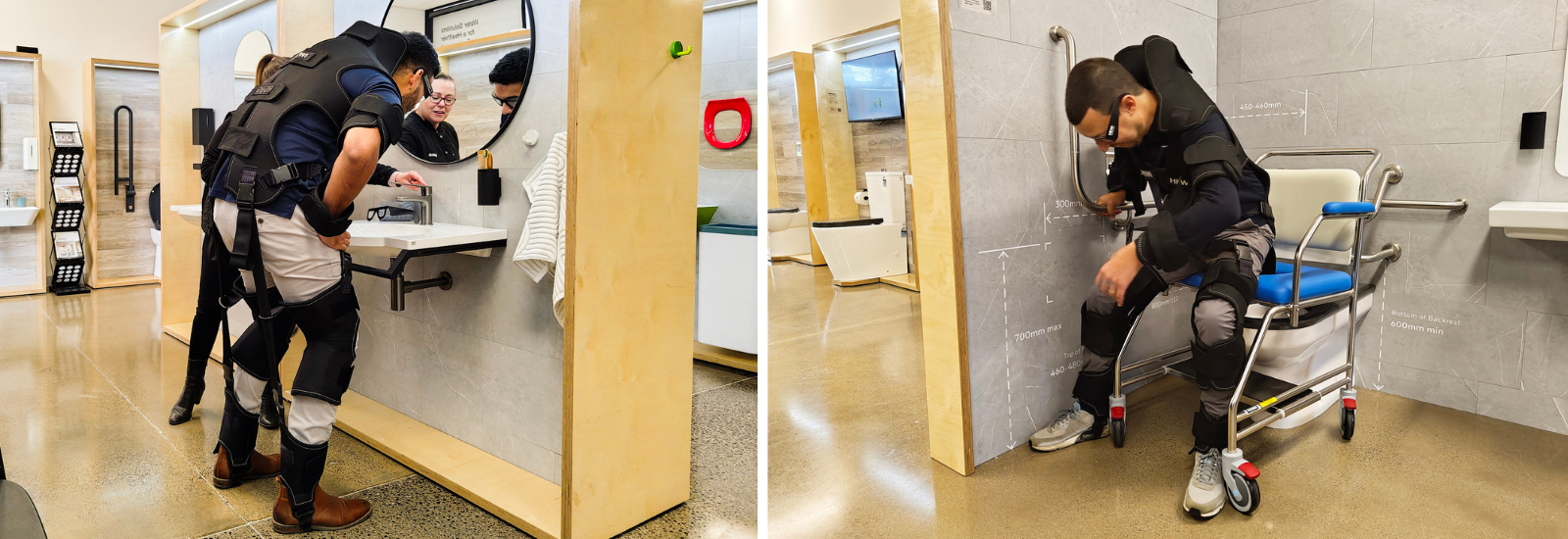
One of the biggest gaps in bathroom design is understanding what the user actually experiences. That’s where the Galvin Experience Centre plays a practical role in the design process. More than a showroom, it allows designers and specifiers to:
- Test products in fully functional bathroom environments
- Experience reduced mobility and dexterity through simulation
- Compare different tapware types and activation methods
- Assess layouts in realistic care and residential scenarios
This hands-on approach highlights issues that aren’t obvious in drawings or specifications and leads to better, more confident decisions.
Small Design Decisions That Change Daily Use
Independence is often shaped by details that seem minor during specification but have a major impact in use.
Tapware operation: The type of control directly affects usability. For example, a user with limited hand strength may struggle with a traditional mixer tap that requires grip and rotation. A push-button or sensor option can significantly reduce effort and allow operation with minimal force.
Practical product choices: Solutions can range from simple grab rails that reduce fall risk, to mixer taps with clear, oversized temperature indicators, through to sensor tapware and smart systems that monitor water use, temperature, or flow.
Placement and reach: Fixtures need to be positioned for real users, not ideal dimensions. This includes seated reach ranges and clearance for mobility aids.
Temperature control: Consistent, safe water temperature reduces risk and removes the need for constant adjustment.
Safety and durability: In environments such as healthcare and mental health, features like ligature resistance and vandal resistance are essential but still need to remain intuitive and non-institutional in appearance.
At the Galvin Experience Centre, these elements can be tested in context, making it easier to understand how each decision affects day-to-day use.
Supporting Independence Across Different Environments
Designing for independence applies across multiple sectors, each with its own challenges:
- Aged care – enabling safe, long-term use as needs change
- NDIS SDA housing – supporting everyday autonomy at home
- Healthcare – reducing risk and supporting recovery
- Mental health – balancing safety requirements with usability
- Education and childcare – encouraging confidence and independence early
While requirements differ, the objective is consistent: make spaces easier to use without assistance.
From Individual Products to Complete Solutions
Independent use isn’t achieved through a single product, it comes from how the entire space works together. This includes:
- Selecting tapware suited to the user’s physical capabilities
- Ensuring compliance with NCC and relevant standards
- Considering durability, maintenance, and whole-of-life performance
- Designing layouts that work for both users and carers when needed
Beyond user experience, well-designed bathroom solutions can also deliver operational benefits. Features such as auto flushing and in-situ disinfection can support infection control, while durable products reduce maintenance requirements and help staff work more efficiently. Monitoring water use and temperature can also provide valuable oversight for facility operators.
The Galvin Experience Centre brings these elements together in full-room environments, helping specifiers move from isolated product decisions to coordinated design outcomes.
Experience It Before You Specify
Good design decisions are easier to make when you can test them. A visit to the Galvin Experience Centre allows you to:
- Trial different product types and configurations
- Validate design choices in real-world conditions
- Better understand user interaction and limitations
- Specify with greater confidence
Because designing for independence is much easier when you’ve experienced the challenges first-hand.
Book a Visit
If you're working on aged care, SDA, mental health or healthcare projects, seeing products in use can change how you specify them.
Book a visit to the Experience Centre and test your design decisions in a real-world environment.
Built on Experience and Compliance
For more than 50 years, Galvin Engineering has supported healthcare, aged care, and public environments across Australia with reliable, compliant water solutions.
All products are designed to meet relevant Australian Standards and requirements, with long-standing certifications including WaterMark, ISO 9001 Quality Management and ISO 14001 Environmental Management.
The result is a range of solutions that support independence, improve usability, and stand up to the demands of real-world environments.
Explore our Aged Care & Dementia Solutions
Frequently Asked Questions
Accessible design, guided by standards like AS 1428 Design for Access and Mobility and the National Construction Code (NCC), sets minimum requirements for safety and access. Independent living design goes further by focusing on:
- Ease of use in everyday situations
- Intuitive operation of fixtures
- Reducing reliance on carers
- Supporting a wider range of physical and cognitive needs
In short, compliance ensures access, independence ensures usability.
Key features include:
- Easy-to-operate tapware (lever, push-button, or sensor)
- Safe, consistent temperature control
- Fixtures positioned within comfortable reach
- Adequate space for mobility aids
- Durable, low-maintenance materials
These elements work together to create a space that supports safe and independent daily use.
Tapware is one of the most frequently used elements in a bathroom, so it has a major impact on independence.
For example, users with limited hand strength may find traditional mixer taps difficult to operate. Alternatives such as push-button or sensor tapware can reduce effort and improve usability.
Features like clear temperature indicators and thermostatic control also help reduce the risk of scalding and improve confidence.
Independent living solutions range from simple to advanced, including:
- Grab rails to reduce fall risk
- Mixer taps with clear, oversized temperature indicators
- Sensor tapware for touch-free operation
- Thermostatic mixing valves for safe temperature control
- Smart systems that monitor water use, flow, or temperature
The right combination depends on the user’s needs and the environment.
Well-designed bathrooms don’t just benefit users, they also improve operational outcomes.
Features such as auto flushing and in-situ disinfection can support infection control, while durable products reduce maintenance requirements. Efficient layouts and reliable fixtures can also help staff work more effectively.
In many cases, good design contributes to lower lifecycle costs and improved service delivery.
Independent living bathrooms must comply with relevant Australian standards and guidelines, including:
- AS 1428 Design for Access and Mobility
- National Construction Code (NCC)
- NDIS Specialist Disability Accommodation (SDA) Design Standard
Products may also require certifications such as WaterMark and compliance with WELS and TMV requirements.
These standards provide a baseline, but additional design considerations are needed to achieve true usability.
Independent living design supports a wide range of users, including:
- People living with disability (including NDIS SDA participants)
- Older adults ageing in place
- Patients in healthcare and rehabilitation environments
- Users in mental health settings
- Children and students in education environments
Ultimately, it creates safer, more intuitive spaces for everyone.
Understanding user needs requires more than guidelines, it requires practical experience.
The Galvin Experience Centre allows designers and specifiers to:
- Test products in real-world bathroom environments
- Experience reduced mobility and dexterity through simulation
- Compare different design approaches in practice
This helps bridge the gap between specification and real-world use.
Yes. The Galvin Experience Centre is open to architects, designers, specifiers and other stakeholders looking to improve their understanding of inclusive and independent living design.
Visitors can explore working bathroom environments, test products, and gain practical insights to support better design decisions.
Bookings are essential to ensure a tailored experience.